Sign in
 Create Account
 Shop
Shop


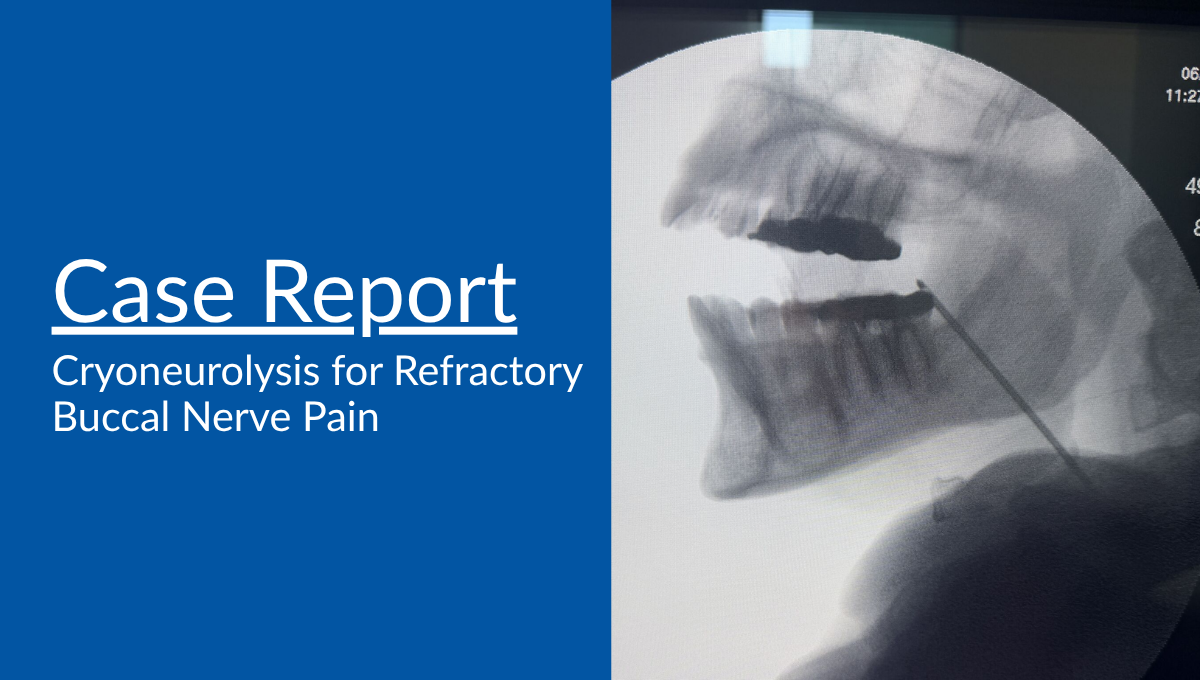
Cryoneurolysis has been used to treat neuropathic dental pain, trigeminal neuralgia, and other chronic pain conditions involving peripheral sensory nerves. The following case, shared by Dr. Arun Kalava, describes a patient who developed persistent neuropathic jaw pain following wisdom tooth extraction. After undergoing extensive diagnostic evaluation, multiple conservative and interventional treatments, and exploratory surgery, the patient was ultimately selected to undergo cryoneurolysis.
Understanding Buccal Nerve Pain
The buccal nerve (also called the long buccal nerve) is a purely sensory branch of the mandibular division of the trigeminal nerve (CN V₃). It is responsible for transmitting sensation from the skin of the cheek, the mucosal lining of the mouth, and the gums adjacent to the lower molars.
Because of its anatomical course, the buccal nerve may be affected following dental procedures, wisdom tooth extractions, trauma, or postoperative scar formation. Injury or irritation of this nerve can result in persistent neuropathic pain characterized by burning sensations, localized tenderness, and hypersensitivity that may significantly impair quality of life.
Clinical Case with Dr Arun Kalava
Arun Kalava, M.D., EDRA
Dr. Arun Kalava is a board-certified anesthesiologist with fellowship training from the Mayo Clinic and founder of TampaPainMD. His clinical practice focuses on regional anesthesia, chronic pain, and ultrasound-guided interventional procedures.
Clinical Case
A 66-year-old male presented with severe right-sided jaw pain that had persisted for more than 12 years. The symptoms developed several months after extraction of his right-sided wisdom teeth. Despite extensive diagnostic testing, no definitive structural cause was identified.
The patient described a constant burning pain rated 8–9/10, precisely localized to the right mandibular molar region. Even gentle pressure over the affected area reliably reproduced his symptoms.
Previous Treatments
Over the course of his treatment, the patient underwent numerous conservative and interventional therapies, including:
- More than 50 different pain medications
- Partial symptom relief with clonazepam
- Oral ketamine therapy
- Steroid injections
- Botulinum toxin injections
- Radiofrequency ablation (performed in late 2022) without meaningful improvement
- Exploratory surgery, during which scar tissue and mandibular fibrous bands were removed
Following surgery, the patient experienced approximately 60% pain reduction for four to five months, after which his symptoms gradually returned.
Diagnostic Findings and Clinical Perspective
To further evaluate the pain generator, a fluoroscopy- and nerve stimulator-guided buccal nerve block was performed using local anesthetic and corticosteroid.
The patient reported greater than 90% pain relief lasting two to three days, supporting the buccal nerve as the primary source of his symptoms and confirming an appropriate target for further intervention.
Why Cryoneurolysis Was Considered
Cryoneurolysis offers several characteristics that make it an attractive option for selected peripheral nerve procedures:
- Minimally invasive, percutaneous technique
- Can be performed in an office or outpatient setting
- Produces reversible axonal interruption while preserving connective tissue architecture
- Allows predictable peripheral nerve regeneration
- May be repeated when clinically appropriate
- Compatible with ultrasound and fluoroscopic guidance
Cryo PainBlocker® System
The Epimed Cryo PainBlocker® system was used in this case. Utilizing the Joule-Thomson effect, the system is capable of achieving temperatures of approximately −70°C. Combined with rapid thawing cycles, the system enables controlled cryolesioning while preserving the endoneurium, perineurium, and epineurium. This approach temporarily interrupts nerve conduction while maintaining the structural framework necessary for predictable nerve regeneration, helping minimize the risk of neuritis and other complications associated with permanent nerve injury.
Learn More about the Cryo PainBlocker® and its applications.
This case is presented for educational purposes only and reflects the clinical experience shared by Dr. Arun Kalava. Individual patient outcomes may vary, and treatment decisions should be based on physician judgment, patient selection, and clinical evaluation.





 United States